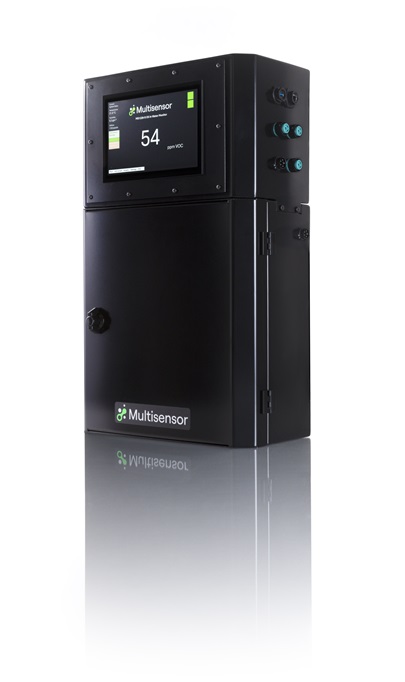
MS1220-S - Oil in Water Analyzer

Hydrocarbons, VOCs, fuels and oils

Detects up to 200 mg/l: ideal for refineries, petrochemical and industrial processes

Request a Quote
MS1220-S Oil in Water Analyzer

The MS1220-S is a high concentration oil in water analyzer designed to monitor water in industrial and petrochemical processes. The presence of pollutants such as BTEX, trichloroethylene (TCE), tetrachloroethylene (PCE or Perc), vinyl chloride, 1,2-dichloroethane, 1,1,1-Trichloroethane, 1,1-dichloroethylene, styrene can lead to heavy fines and process contamination. The instrument works by sensing gases or volatiles to provide a non-contact measurement system with very low maintenance requirements.

Applications

  • Oil detection in Cooling Water
  • Oil detection in produced water
  • Detection of phenols in discharge water
  • Effluent monitoring
  • Pre-filtration monitoring
  • Oil in wastewater
  • Filter protection

Features and benefits

  • No sensor contact with water: low maintenance, no sensor cleaning
  • Measures both Polycyclic Aromatic Hydrocarbons (PAHs) and VOCs
  • Electronic Nose: not affected by turbidity
  • Can be calibrated for specific substances: used to monitor known spills
  • Catches fluorescent and non-fluorescent compounds
  • Alarms to SCADA and other communication interfaces

For more information on the principle of operation, click on the FAQs tab.

Request a Quote

The MS1220-S oil in water analyzer is designed to detect concentrations of up to 200 mg/l and it’s used in a variety of applications such as:

Oil in cooling water

Hydrocarbons are an ever present class of compounds in industrial processes, factories and industrial plants of all sorts. A leaking piece of equipment, a corroded heat exchanger, a leaking diesel pump or simply an accidental spill can mean that cooling water gets contaminated with hydrocarbons. When this happens an oil in water analyzer, like the MS1220-S, can help to detect contamination in the cooling water early on before it creates major issues.

Phenols

Phenols are widely used in industry as one of the starting material to produce plastics, explosives and drugs, however, they can be harmful for the environment and companies that deal with phenols need to comply with very strict emission limits.

Influent water

Wherever water and hydrocarbons get mixed together in a process (refineries, petrochemical processes etc) there is a need to treat this water before it’s used further down in the process or discharged into the environment. This influent water usually has high levels of hydrocarbons and, depending on the incoming level, the treatment can be optimized.

Request a Quote

PARAMETER OPERATIONAL REQUIREMENTS NOTES
Minimum Maximum
Detection Range 1 ppm 200 ppm Total VOCs
Display Range (Default) 0 ppm 200 ppm Configurable on commissioning
Repeatability -2% +2% +/-15% from 20 to 100 ppm, measured with a 50 ppm toluene solution at standard temperature and pressure; accuracy can be further improved at concentration of interest, using bespoke calibration available on request.
Accuracy -10% +10%
Measurement Frequency Continuous
Ambient Temperature 0 °C / 32 °F 50 °C / 122 °F Climate control might be needed depending on process and ambient conditions
Water Temperature 1 °C / 34 °F 50 °C / 122 °F
Analog Input 4 mA 20 mA Scalable to range required, max load 750 Ω loop powered or instrument powered
Analog Output 4 mA 20 mA
Analog Output Isolation 5 kVAC, 400 VDC
Relay Current 5 A Max. 250 VAC or 30 VDC; 3x: Alarm 1, 2 and Fault Relays with NO and NC contacts
Interface Touchscreen With advanced reporting capabilities
Communication Protocols Modbus (Optional) Profibus / HART / Foundation Fieldbus on request
Data Storage μSD Card / Windows PC 6 months
Instrument Case IP65 Powder coated stainless steel
System Weight 30 kg / 66 lbs
Sampling Tank 316 Stainless Steel
Flow Limit Switch Option available on request
Water Flow Rate 2 l/min / 0.52 US gpm
System Dimensions 650 x 960 x 400 mm
25.59 x 37.80 x 15.75 inches
Supply Voltage 90 V AC
9 VDC
240 V AC
36 VDC
50 Hz or 60 Hz
Power Consumption
45 W
Typical 20 W during operation
Consumables 6 Months: Filter and restrictor

Service: Service is necessary every 6 months to keep the instrument operating in optimal conditions. Air Pump replaced every 18-36 months as required. Service should be carried out by a trained technician who has undergone the standard Multisensor Systems training course.

View Datasheet

Title Type Format
MS1220-S - Oil in Water Analyzer Datasheet PDF
What does the MS1220-S measure?
It measures the concentration VOC in water measured against a target gas standard (usually toluene). Other compounds can be targeted.
How often does the instrument provide a reading?
The instrument provides a reading via the 4-20 mA output continuously.
What is the reported value?
The reported value is Total VOCs in the effluent water, in ppm, is in the range from 1 ppm to 200 ppm
What is the principle of operation
The system samples the air above the effluent/sewage continuously; this air is then passed through the sensor which reacts with VOCs and measures their concentration. The concentration is then reported via the analog output.
How is the analyzer calibrated?
The instrument is factory calibrated against toluene.
What are common target gases?
Petroleum Gas, Methane, Iso Butane, Kerosene, Ethanol, Diesel, Iso-butylene, Toluene, Acetone, Xylene, Heptane, Benzene, Methanol Mercaptan
What is the required maintenance? Is it expensive?
The instrument requires a service every 6 months to replace some low-cost components such as activated carbon filters and to make sure that there are no air leaks.
What is the warranty?
Every instrument comes with 1 year warranty from the shipment date
How does the analyzer alert the user to high concentrations of gas?
It incorporates a relay which is switched at a user definable threshold. This can be hardwired to valves/pumps and so on to stop processes very quickly. Alternatively the users SCADA system can also be used.

Request a Quote